
Short answer
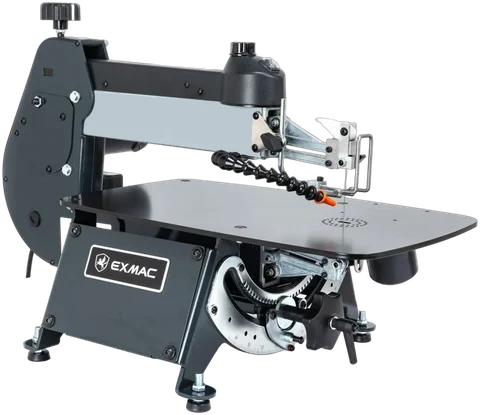
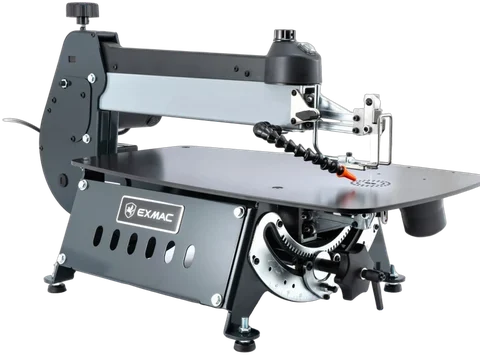
Choose a scroll saw by the largest piece you need to turn around the blade, then by your bench space. Among EXMAC scroll saws, the EX16 has a 16" throat for fretwork and smaller work, and the EX21 has a 21" throat and larger table for signs and larger panels.
Key points
- Throat depth is the main difference: it sets how far the blade can reach into a panel.
- Size the saw from the largest piece you cut repeatedly, not a one-off project.
- Compare current EX16 and EX21 pricing on their product pages, then let your work and bench decide.
- A tilting arm keeps the table level, so the work stays flat during bevel cuts.
What should you look for in a scroll saw?
A scroll saw drives a thin, narrow blade up and down, which lets you steer the wood through tight curves. Because the blade can be released and threaded through a drilled hole, it can also make interior cuts that never touch the edge of the board. Four things shape how a scroll saw works in daily use.
Throat depth
Throat depth is the distance from the blade to the rear of the frame, and it is the number in the name of both EXMAC models.
Tilting arm or tilting table
Some scroll saws tilt the table for bevel cuts, which also tilts your work. The EX16 and EX21 tilt the arm instead, so the table stays level and the workpiece stays flat under your hands.
Blade changes for pierced work
A pierced pattern can mean releasing and re-threading the blade many times in one project. On both EXMAC models the blade changes without tools and the upper arm lifts for threading. The two saws share this routine, so it will not decide between them, but it is worth comparing against any other saw you are considering.
Speed control
Slower speeds give you more control on tight turns and can reduce burning on dense wood. Faster speeds suit straighter runs. Both models offer variable speed. The EX16 runs at 400–1,400 CPM (cuts per minute, also called strokes per minute). Ask EXMAC for the EX21's range.
EX16 vs. EX21: what is the difference?
| Feature | EX16 | EX21 |
|---|---|---|
| Throat | 16" | 21" |
| Table | Smaller than the EX21's | Larger table, epoxy-coated steel |
| Typical projects | Ornaments, fretwork, small boxes, and detailed parts | Larger signs, deeper interior cuts, and larger panels |
| Price | $649.99 | $699.99 |
Both models have a tilting arm, variable speed, tool-free blade changes, a lifting upper arm, a dust port, and an optional foot switch. Prices are from the product pages at the time of this update. See the EX16 and EX21 pages for current price and availability.
Which EXMAC scroll saw fits your projects?
Start with the largest piece you expect to guide through the saw, not the small ornament you make most often. A compact project can be cut on either model, but a larger pattern becomes awkward if the work cannot rotate without touching the frame.
Here is a quick test. Mark a blade point on your bench, then measure 16" and 21" behind it to see where each frame would sit. Rotate a cardboard template of your largest piece around that point. If it clears at 16", the EX16 is likely enough. If it only clears at 21", look at the EX21.
Compare current EX16 and EX21 pricing on their product pages, then let your work and bench decide.
What should you check before you buy a scroll saw?
- Space: measure the bench, then leave room behind and beside the saw for the largest rotation you expect.
- Position: set the saw so your shoulders stay relaxed and you can see the blade path. If you sit, allow for the chair and a foot control.
- Power: before you order, ask EXMAC for the required voltage and circuit, and have a qualified electrician confirm your shop can supply it.
- Dust: plan the hose so it does not pull on the work or get in the way of blade changes or bevel cuts.
- Accessories: the Variable Speed Foot Switch fits the EX16 and EX21. A Scroll Saw Stand is also available; confirm the fit with EXMAC.
- Delivery: EXMAC ships within the United States only. Larger machines ship by freight and may need a delivery appointment, liftgate service, or unloading help, with possible carrier charges. Inspect the crate before you sign. See Shipping & Delivery.
How do you use a scroll saw safely?
Safety
- Read the complete manual before assembly or use. You can download it from Manuals & Downloads.
- Disconnect power before blade changes, cleaning, adjustment, or service.
- Wear eye protection, and keep guards and hold-down parts installed.
- Keep your fingers clear of the blade path.
Frequently asked questions
What does throat depth mean on a scroll saw?
Throat depth is the distance from the blade to the rear of the frame. It limits how far into a panel the blade can reach. The EX16 has a 16" throat and the EX21 has a 21" throat.
Is the EX16 or the EX21 better for a beginner?
Neither is better by default. Choose by the size of the projects you plan to make. If they are small and your bench is limited, start with the EX16. If you already want to cut larger signs or panels, start with the EX21.
Is the EX21 worth the extra cost over the EX16?
Compare current EX16 and EX21 pricing on their product pages, then let your work and bench decide.
Why does a tilting arm matter?
A tilting arm keeps the table level during bevel cuts, so the work stays flat. On a tilting-table saw, the work tilts along with the table.
Can I use a foot control with these saws?
Yes. The EXMAC Variable Speed Foot Switch is listed for both the EX16 and the EX21.
What warranty comes with an EXMAC scroll saw?
EXMAC machines come with a 2-year limited warranty. An optional 3-year extension can be added only when you buy the machine. See the Warranty page for the terms.
What should you do next?
- See the EX16The 16" throat model
- See the EX21The 21" throat model
- Compare machinesBoth models side by side
- Scroll saw accessoriesStand and foot switch
- Manuals & downloadsDownload your manual
- Ask EXMACQuestions before you order
Not sure a scroll saw is the right first machine? Read which woodworking machine to buy first, or see how to choose a bandsaw and choose a wood lathe.
Written by the EXMAC Product Support Team. EXMAC machines are made in Taiwan and sold and supported in the U.S. Model details come from EXMAC product pages. Project suggestions are general guidance, so confirm your setup with EXMAC before you order.